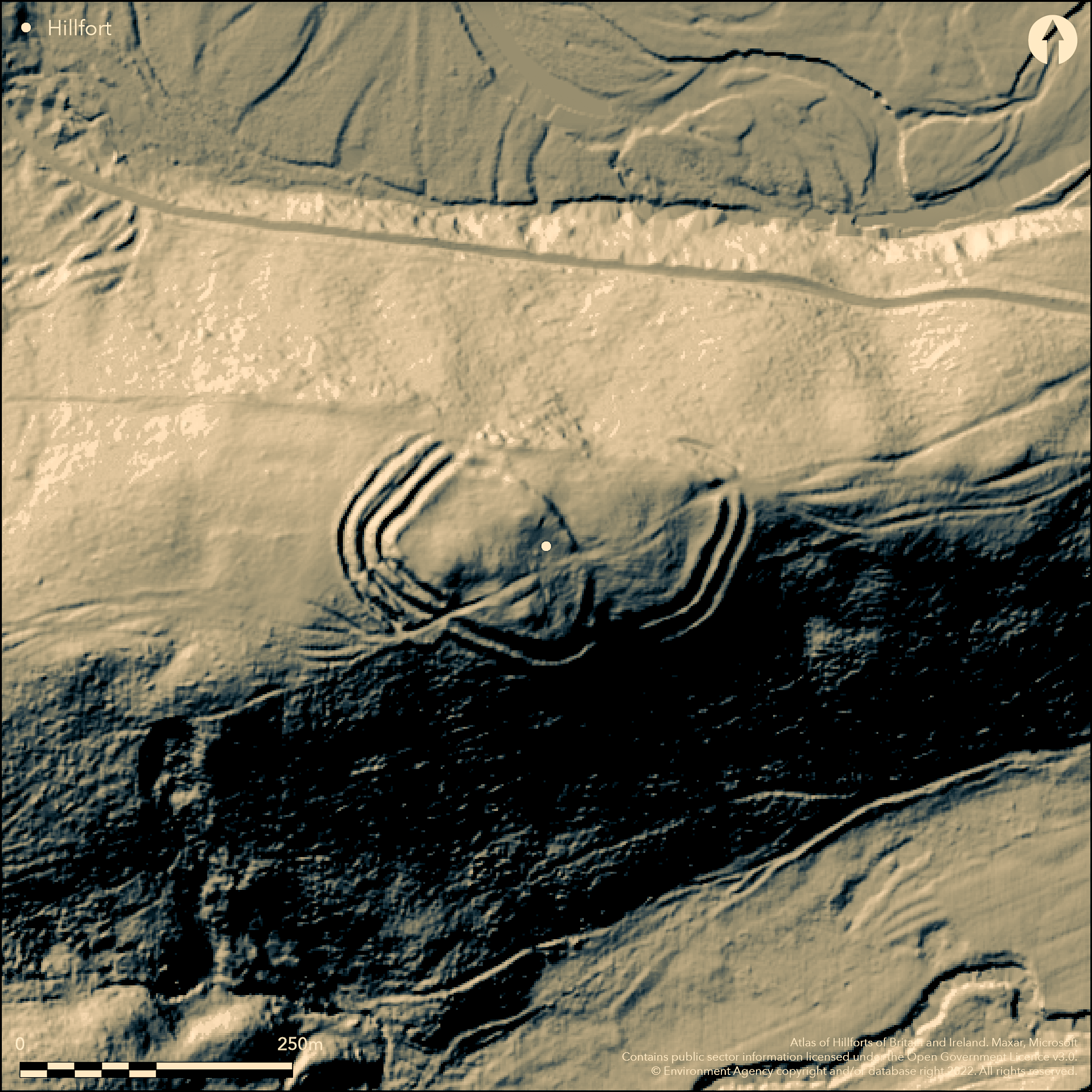
LiDAR 1m DTM Hillshade
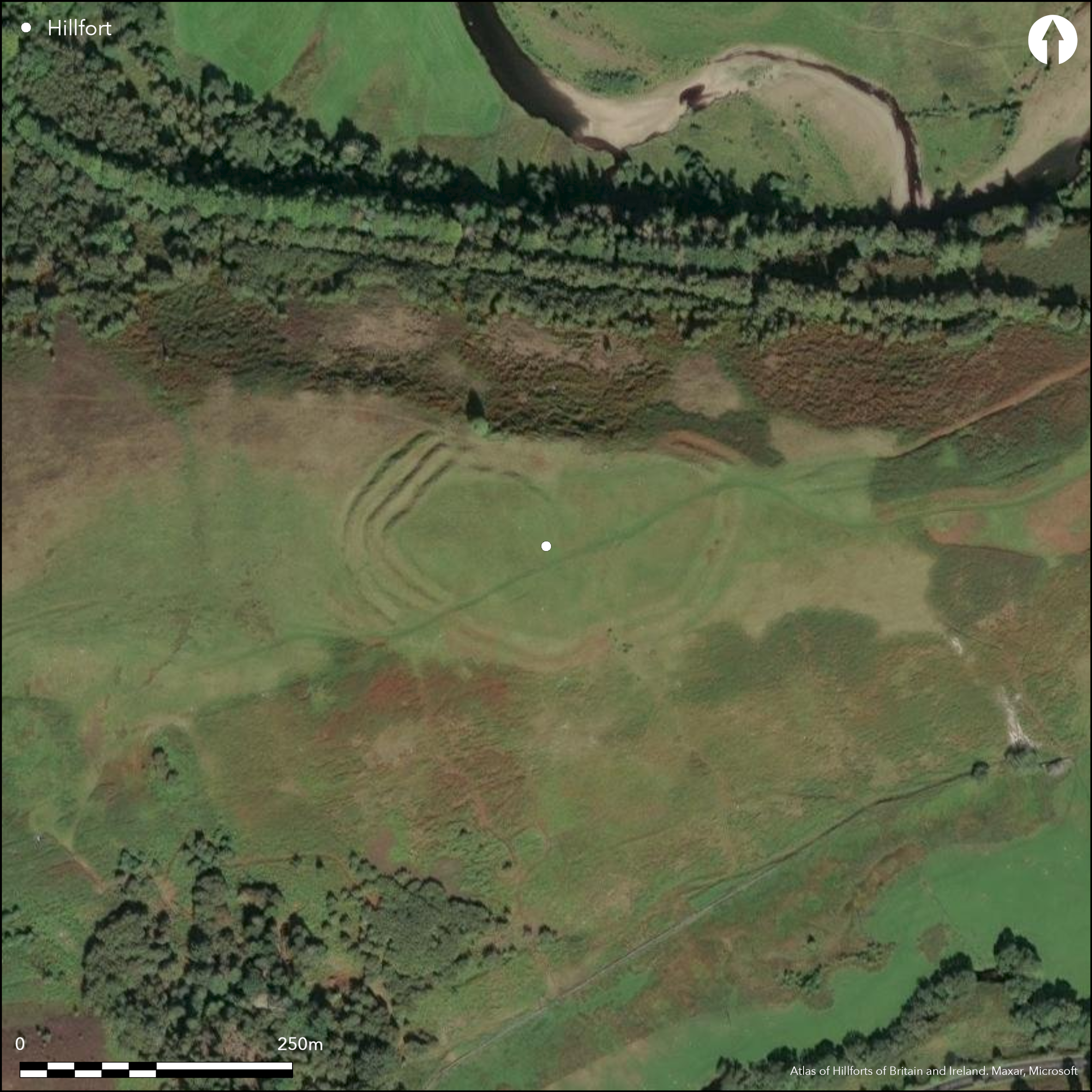
Satellite Imagery
LiDAR 1m DTM Hillshade
Satellite Imagery
Scroll left/right to view further images.
HER: Northumberland 9694 (None)
NMR: NY 99 NE 6 (19523)
SM: 1011397
NGR: NY 96947 99798
X: 396947 Y: 599798 (OSGB36)
Lying at 168m OD on a promontory overlooking the confluence of the Grasslees Burn and the River Coquet, a multivallate hillfort occupied from the 4th-1st century BC. The surface remains are sub-oval in form, measuring 160m E-W by 100m N-S enclosing approximately 1.5ha. It evolved from an earlier smaller enclosure of 0.6ha with a central entrance, the visible remains of which form an arc running centrally through the hillfort. It lies on the highest part of an E-W ridge and comprises four turf-covered earth and stone ramparts in the W surviving up to 4m above three 1.2m wide medial ditches. Two ramparts lie in the S and E with a medial ditch between. The inner rampart survives as a steep scarp lying 3m above the 2.5m wide ditch, with the outer rampart 5m wide and 1.3m high about the ditch. In the N only slight traces of a single rampart remain, augmented by the natural slope. Traces of an outer ditch and counterscarp have also been recorded in the S and E. The results from a trial excavation in 1994 suggest two or three phases of rampart construction possibly with a dump of glacial material upcast from the ditch in phase I. This was faced with stone forming a 2.2m wide rampart in phase IIa and might have been contemporary with a palisade slot cut to hold a wooden breastwork. Fills from the ditch were seen by Waddington et al. (1998) to indicate episodes of silting and turf build up from several phases of occupation. Conservation-led archaeological work was carried out in 2001-2 to assess the level of damage that was occurring through sheep and rabbits and bracken roots (summarized in Carlton 2002). Magnetometry and resistance surveys (Biggins 2001) also showed two or more phases of construction beginning with the 0.6ha oval univallate enclosure which had measured 100m E-W by 70m N-S. Three ditches in the centre of the enclosure were seen to align on this earthwork. The central ditch continued southwards and was contiguous with the southern enclosure. The flanking ditches terminate approximately 10m from what it considered to be an original entrance in the W. The eastern sector of the enclosure had fewer features and was thought to have had an agricultural function. In the W a number of anomalies were recorded including pits and circular features although the evidence for buildings is slight. The smaller enclosure was later extended on the S and W sides by a larger enclosure. Further excavations at this time across the inner ramparts lent support to the construction phases identified by (Waddington et. al. 1998), although rabbit damage prevented this being confirmed in all trenches. Four breaks occur in the rampart, two of which carry a track that runs NE-SW. A further break in the NW is possibly original. A possible Bronze Age cairn lies within the enclosure in the SW. Environmental and other deposits indicated a range of domestic and industrial practices with iron slag recovered from six of the eleven trenches suggesting iron working, probably smelting as well as smithing was being carried out (ibid. 103). Radiocarbon analysis has confirmed two distinct phases of activity between the mid-4th and mid-1st century BC, with artefactual evidence suggesting an earlier, Neolithic presence on the hill, the shale armlet indicative of possible early Roman activity. Conservation work on the ramparts began in 2015. The site is recorded on 1866 1:10,560 OS mapping. Scheduled
Citizen Science: ✗
Reliability of Data: Confirmed
Reliability of Interpretation: Confirmed
X: -228162 Y: 7418807 (EPSG: 3857)
Longitude: -2.0496164945967053 Latitude: 55.292317436871485 (EPSG:4326)
Country: England
Current County or Unitary Authority: Northumberland
Historic County: Northumberland
Current Parish/Community/Council/Townland: Harbottle
An evaluation carried out in 2002 using coring and targeted excavation to assess the preservation of the ramparts showed that rabbit burrowing has caused considerable damage to the earthworks. On Heritage at Risk Register (2015). Conservation work on the ramparts commenced in 2015
| Extant | ✓ |
| Cropmark | ✗ |
| Likely Destroyed | ✗ |
Upland heath
| Woodland | ✗ |
| Commercial Forestry Plantation | ✗ |
| Parkland | ✗ |
| Pasture (Grazing) | ✗ |
| Arable | ✗ |
| Scrub/Bracken | ✗ |
| Bare Outcrop | ✗ |
| Heather/Moorland | ✗ |
| Heath | ✓ |
| Built-up | ✗ |
| Coastal Grassland | ✗ |
| Other | ✗ |
A hillslope fort lying on an inland promontory at 168m OD
| Contour Fort | ✗ |
| Partial Contour Fort | ✗ |
| Promontory Fort | ✗ |
| Hillslope Fort | ✓ |
| Level Terrain Fort | ✗ |
| Marsh Fort | ✗ |
| Multiple Enclosure Fort | ✗ |
| Hilltop | ✗ |
| Coastal Promontory | ✗ |
| Inland Promontory | ✓ |
| Valley Bottom | ✗ |
| Knoll/Hillock/Outcrop | ✗ |
| Ridge | ✗ |
| Cliff/Plateau-edge/Scarp | ✗ |
| Hillslope | ✓ |
| Lowland | ✗ |
| Spur | ✗ |
Dominant Topographic Feature: Inland promontory
| North | ✗ |
| Northeast | ✗ |
| East | ✗ |
| Southeast | ✗ |
| South | ✗ |
| Southwest | ✓ |
| West | ✗ |
| Northwest | ✗ |
| Level | ✗ |
Altitude: 168.0m
N/A
The site has been radiocarbon dated showing at least two main periods of use from 4th to the 1st century BC (Carlton 2002): OXA-13461 2161±29 350_160 cal bc 360_110 cal bc; OXA-13462 2114±30 200_60 cal bc 350_40 cal bc; OXA-13463 2091±30 170_40 cal bc 200_10 cal bc; OXA-13464 2231±31 380_200 cal bc 400_180 cal bc; OXA-13465 2194±30 360_180 cal bc 380_160 cal bc; OXA-13466 2178±29 360_170 cal bc 360_120 cal bc.
Reliability: A - High
| Pre 1200BC | ✗ |
| 1200BC - 800BC | ✗ |
| 800BC - 400BC | ✓ |
| 400BC - AD50 | ✓ |
| AD50 - AD400 | ✗ |
| AD400 - AD 800 | ✗ |
| Post AD800 | ✗ |
| Unknown | ✗ |
| Pre Hillfort: | None |
| Post Hillfort: | None |
| Artefactual: | None |
| C14: | None |
| Morphology/Earthwork/Typology: | None |
Detailed description and plan produced by Mackenzie (1825, 49-50), with subsequent brief accounts by MacLauchlan (1867, 85_6), Dixon (1903, 121), Phillips (1957) and Jobey (1965, 25_6). Recorded on 1866 1:10,560 OS mapping. Ordnance Survey field investigation in 1957 and 1971. Surveyed at 1:1000 scale by RCHME (Blood 1994), ref. no. 892643. Single evaluation trench by Newcastle University in 1994. Conservation led archaeological work in 2001-2 including the excavation of eleven trenches and magnetometry and resistance surveys (Cartlon 2002; Biggins 2001). Material taken for environmental assessment and Radiocarbon dating. Field investigations 1957 1971. 2015 Work began on conserving the ramparts. Scheduled.
| 1st Identified Written Reference (1825): | Description and Plan |
| 1st Identified Map Depiction (1866): | None |
| Other (1932): | Scheduled |
| Other (1957): | Field investigation |
| Other (1971): | Field investigation |
| Earthwork Survey (1994): | None |
| Excavation (1998): | None |
| Geophysical Survey (2001): | None |
| Excavation (2002): | None |
| Other (2015): | Conservation work on ramparts |
Roundhouses, ditches and pits shown by geophysics. Range of finds including pottery, metal, metal working and animal bones.
River Coquet and Harehaugh Burn to the N
| None | ✓ |
| Spring | ✗ |
| Stream | ✗ |
| Pool | ✗ |
| Flush | ✗ |
| Well | ✗ |
| Other | ✗ |
None
| No Known Features | ✓ |
| Round Stone Structures | ✗ |
| Rectangular Stone Structures | ✗ |
| Curvilinear Platforms | ✗ |
| Other Roundhouse Evidence | ✗ |
| Pits | ✗ |
| Quarry Hollows | ✗ |
| Other | ✗ |
Ramparts only excavated
| No Known Excavation | ✓ |
| Pits | ✗ |
| Postholes | ✗ |
| Roundhouses | ✗ |
| Rectangular Structures | ✗ |
| Roads/Tracks | ✗ |
| Quarry Hollows | ✗ |
| Other | ✗ |
| Nothing Found | ✗ |
Ditches
| No Known Geophysics | ✗ |
| Pits | ✓ |
| Roundhouses | ✓ |
| Rectangular Structures | ✗ |
| Roads/Tracks | ✗ |
| Quarry Hollows | ✗ |
| Other | ✓ |
| Nothing Found | ✗ |
None
| No Known Finds | ✗ |
| Pottery | ✓ |
| Metal | ✓ |
| Metalworking | ✓ |
| Human Bones | ✗ |
| Animal Bones | ✓ |
| Lithics | ✓ |
| Environmental | ✓ |
| Other | ✗ |
None
| APs Not Checked | ✓ |
| None | ✗ |
| Roundhouses | ✗ |
| Rectangular Structures | ✗ |
| Pits | ✗ |
| Postholes | ✗ |
| Roads/Tracks | ✗ |
| Other | ✗ |
Four breaks occur in the rampart two of which carry a track which runs NE-SW a further break in the NW is possibly original.
| 4: | None |
| 2: | None |
Guard Chambers: ✗
Chevaux de Frise: ✗
| 1. Simple Gap (North west): | None |
Multivallate hillfort, sub-oval in form, measuring 160m E-W by 100m N-S enclosing approximately 1.5ha. It evolved from an earlier smaller enclosure of 0.6ha, the remains of which form an arc running centrally through the hillfort. It comprises four turf-covered earth and stone ramparts in the W surviving up to 4m above three 1.2m wide medial ditches. Two ramparts lie in the S and E with a medial ditch between. The inner rampart survives as a substantial steep scarp 3m above the 2.5m wide ditch, with the outer rampart 5m wide and 1.3m high about the ditch. In the N only slight traces of a single rampart remain, augmented by the natural slope. Traces of an outer ditch and counterscarp have also been recorded in the S and E. Two or possibly three phases of rampart construction comprising a dump of glacial material upcast from the ditch in phase I. This was faced with stone forming a 2.2m wide rampart in phase IIa and possibly contemporary with a palisade slot cut to hold a wooden breastwork. Fills from the ditch indicated episodes of silting and turf build up suggesting several phases of occupation (Waddington et al. 1998).
| Area 1: | 0.6ha. |
| Area 2: | 1.5ha. |
| Total: | 1.5ha. |
Total Footprint Area: 2.5ha.
None
| ✓ | None |
| ✓ | Absent in places in the N |
| NE Quadrant: | 1 |
| SE Quadrant: | 2 |
| SW Quadrant: | 4 |
| NW Quadrant: | 1 |
| Total: | 4 |
| Partial Univallate | ✓ |
| Univallate | ✗ |
| Partial Bivallate | ✓ |
| Bivallate | ✗ |
| Partial Multivallate | ✓ |
| Multivallate | ✗ |
| Unknown | ✗ |
| Partial Univallate | ✗ |
| Univallate | ✓ |
| Partial Bivallate | ✗ |
| Bivallate | ✗ |
| Partial Multivallate | ✗ |
| Multivallate | ✗ |
Palisade detected by geophysics
| None | ✗ |
| Earthen Bank | ✓ |
| Stone Wall | ✗ |
| Rubble | ✗ |
| Wall-walk | ✗ |
| Evidence of Timber | ✗ |
| Vitrification | ✗ |
| Other Burning | ✗ |
| Palisade | ✓ |
| Counter Scarp Bank | ✓ |
| Berm | ✗ |
| Unfinished | ✗ |
| Other | ✗ |
Palisade trench possibly for a timber breastwork
| None | ✗ |
| Earthen Bank | ✓ |
| Stone Wall | ✓ |
| Murus Duplex | ✗ |
| Timber-framed | ✗ |
| Timber-laced | ✗ |
| Vitrification | ✗ |
| Other Burning | ✗ |
| Palisade | ✓ |
| Counter Scarp Bank | ✗ |
| Berm | ✗ |
| Unfinished | ✗ |
| No Known Excavation | ✗ |
| Other | ✓ |
| ✗ | None |
| ✓ | None |
Number of Ditches: 3
| ✗ | None |
Biggins, A. J. 2001. A Geophysical Survey at Harehaugh Hillfort, Holystone, Northumberland. Timescape Archaeological Surveys. Unpublished report.
Carlton, R. 2002. Harehaugh Hillfort, Northumberland, Archaeological Project. The Archaeological Practice. Newcastle upon Tyne
Carlton, R. 2002. Archaeological Excavations at Harehaugh Hillfort in 2002. Archaeol Aeliana. 5/41. 85-115
Dixon, D. D. 1903. Upper Coquetdale, Northumberland: its history, traditions, folk-lore and scenery . Robert Redpath, Newcastle upon Tyne, 121-2.
Jobey, G. 1965 Hill forts and settlements in Northumberland. Archaeol Aeliana 43, 21-64
Mackenzie, E. 1825. An historical, topographical, and descriptive view of the county of Northumberland, Vol. II. Mackenzie and Dent. Newcastle.
Phillips, A. S. 1957. Harehaugh Hillfort: Ordnance Survey Field Investigator's Internal Report. Ordnance Survey (Unpublished).
Waddington, C., Blood, K., and Crow, J. 1998. Survey and excavation at Harehaugh Hillfort and possible Neolithic enclosure. Northern Archaeology. Volume 15/16, 87-106
Waddington, C. 1994. Newcastle University Interim Excavation Report
Atlas of Hillforts:
Wikidata:
This work is licensed under CC BY-SA 4.0

 and should be cited as:
Lock, Gary and Ralston, Ian. 2024. Atlas of Hillforts of Britain and Ireland. Available at: https://hillforts.arch.ox.ac.uk
Document Version 1.1