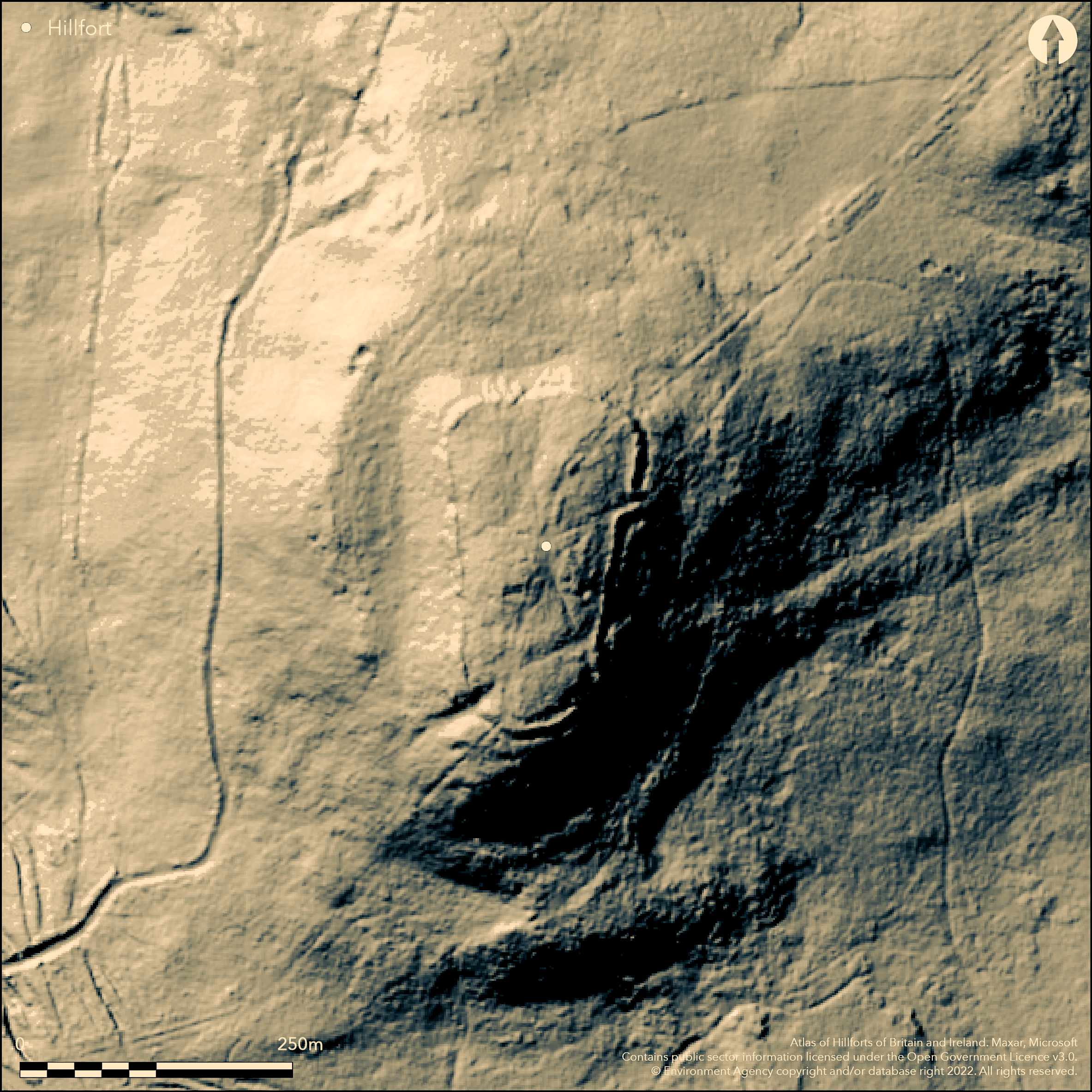
LiDAR 1m DTM Hillshade
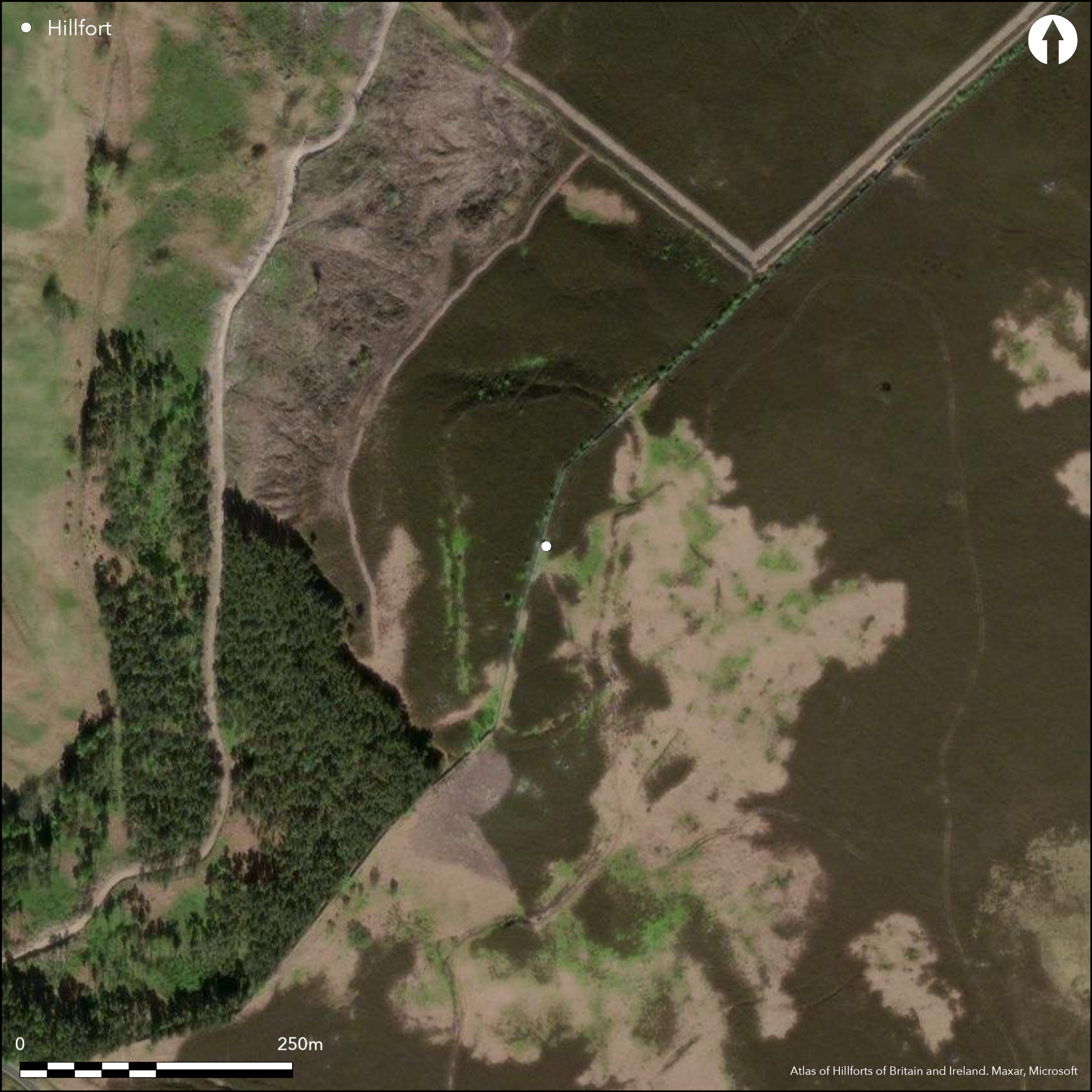
Satellite Imagery
LiDAR 1m DTM Hillshade
Satellite Imagery
Scroll left/right to view further images.
HER: Northumberland 3391 (10208/MNA124826 (NT))
NMR: NU 02 NE 3 (5431)
SM: 1006565
NGR: NU 08114 25331
X: 408114 Y: 625331 (OSGB36)
Holding a prominent position in the landscape at 316m OD and partially within the eastern edge of Chillingham Park, a univallate contour fort of 1.24ha. Occupying the summit of the hill, the hillfort has extensive views in all directions. The enclosing work is an elongated oval being slightly wider in the N, measuring approximately 170m N-S by 90m E-W. It comprises a single earth and stone bank approximately 0.2-1m high internally and 1.5-3m externally which runs below the summit of the hill. The outer face might once have had a retaining stone wall, which survives today as a single course. Slight traces also exist of an inner face between which the inner rubble core has been exposed by erosion. An intermittent external ditch lies in the S, E and NE. In the W the rampart has been formed by scarping the natural slope. A substantial rock outcrop is incorporated into its SE side. A 1.8m wide entrance marked with boulders and slabs and with out-turned banks lies in the NE on the easiest line of approach. A further break, possibly an original entrance, lies in the SW. Within the hillfort two circular depressions have been interpreted as the remains of hut circles. Various quarry hollows have also been identified. A field wall running approximately NW to SE cuts through the enclosure. Surveys were carried out by MacLauchlan in 1864 (reproduced in Hardie 2010) and RCHME in 1990. Survival of the hillfort is variable and it has severe erosion problems due to public access. The site is unexcavated but presumed Iron Age. Five rock outcrops with cup marked motifs lie outside the hillfort to the W and E. Recorded on 1866 1:10,560 OS mapping. Scheduled.
Citizen Science: ✗
Reliability of Data: Confirmed
Reliability of Interpretation: Confirmed
X: -208505 Y: 7463782 (EPSG: 3857)
Longitude: -1.8730337608820669 Latitude: 55.52169455700531 (EPSG:4326)
Country: England
Current County or Unitary Authority: Northumberland
Historic County: Northumberland
Current Parish/Community/Council/Townland: Chillingham
The pathways installed by the National Trust to protect the site are now also suffering from visitor erosion (Hardie 2010).
| Extant | ✓ |
| Cropmark | ✗ |
| Likely Destroyed | ✗ |
Presented to the National Trust in 1936 as a memorial to Sir Edward Grey. The land to the E of the boundary wall is owned by the National Trust and it lies partly within Chillingham Grade II Registered Park and Garden.
| Woodland | ✗ |
| Commercial Forestry Plantation | ✗ |
| Parkland | ✓ |
| Pasture (Grazing) | ✗ |
| Arable | ✗ |
| Scrub/Bracken | ✓ |
| Bare Outcrop | ✗ |
| Heather/Moorland | ✓ |
| Heath | ✗ |
| Built-up | ✗ |
| Coastal Grassland | ✗ |
| Other | ✗ |
A univallate contour fort lying at 316m OD on level ground on the summit of Ros Hill. The location offers extensive views in all directions
| Contour Fort | ✓ |
| Partial Contour Fort | ✗ |
| Promontory Fort | ✗ |
| Hillslope Fort | ✗ |
| Level Terrain Fort | ✗ |
| Marsh Fort | ✗ |
| Multiple Enclosure Fort | ✗ |
| Hilltop | ✓ |
| Coastal Promontory | ✗ |
| Inland Promontory | ✗ |
| Valley Bottom | ✗ |
| Knoll/Hillock/Outcrop | ✗ |
| Ridge | ✗ |
| Cliff/Plateau-edge/Scarp | ✗ |
| Hillslope | ✗ |
| Lowland | ✗ |
| Spur | ✗ |
Dominant Topographic Feature: Hilltop
| North | ✗ |
| Northeast | ✗ |
| East | ✗ |
| Southeast | ✗ |
| South | ✗ |
| Southwest | ✗ |
| West | ✗ |
| Northwest | ✗ |
| Level | ✓ |
Altitude: 316.0m
N/A
Undated, presumed Iron Age
Reliability: D - None
| Pre 1200BC | ✗ |
| 1200BC - 800BC | ✗ |
| 800BC - 400BC | ✗ |
| 400BC - AD50 | ✗ |
| AD50 - AD400 | ✗ |
| AD400 - AD 800 | ✗ |
| Post AD800 | ✗ |
| Unknown | ✓ |
| Pre Hillfort: | None |
| Post Hillfort: | Earthwork remains of a post-medieval beacon possibly described in a 1549 list as 'Rosse Castell'. A post medieval boundary wall which marks the land owned by Chillingham Park crosses the monument running approximately NE-SW. Trig point |
| Morphology/Earthwork/Typology: | None |
Shown as 'Rause' Castle by Mercator in 1595. General reference in Parson and Wright Trade Directory (1827). Recorded on 1866 1:10,560 OS mapping. Survey by MacLauchlan in 1864 (reproduced in Hardie 2010, 13) and RCHME 1990. A full report was carried out in 2010 for the National Trust (Hardie, 2010). Field investigations in 1955, 1969 and 1974. Scheduled.
| 1st Identified Map Depiction (1595): | Gerhard Mercator |
| 1st Identified Written Reference (1827): | None |
| Earthwork Survey (1858): | MacLauchlan |
| Other (1932): | Scheduled |
| Other (1955): | Field investigation |
| Other (1969): | Field investigation |
| Other (1974): | Field investigation |
| Earthwork Survey (1990): | RCHME |
| Other (2010): | Hardie, C. Report for the National Trust |
MacLauchlan recorded both a spring in the SE and a stream inside the hillfort in 1895 (Hardie 2010). Circular depressions interpreted as the remains of huts; quarry hollows, possibly contemporary with the construction of the bank, also later quarries
None
| None | ✗ |
| Spring | ✓ |
| Stream | ✓ |
| Pool | ✗ |
| Flush | ✗ |
| Well | ✗ |
| Other | ✗ |
Depressions, possibly the remains of huts
| No Known Features | ✗ |
| Round Stone Structures | ✗ |
| Rectangular Stone Structures | ✗ |
| Curvilinear Platforms | ✗ |
| Other Roundhouse Evidence | ✓ |
| Pits | ✗ |
| Quarry Hollows | ✓ |
| Other | ✗ |
None
| No Known Excavation | ✓ |
| Pits | ✗ |
| Postholes | ✗ |
| Roundhouses | ✗ |
| Rectangular Structures | ✗ |
| Roads/Tracks | ✗ |
| Quarry Hollows | ✗ |
| Other | ✗ |
| Nothing Found | ✗ |
None
| No Known Geophysics | ✓ |
| Pits | ✗ |
| Roundhouses | ✗ |
| Rectangular Structures | ✗ |
| Roads/Tracks | ✗ |
| Quarry Hollows | ✗ |
| Other | ✗ |
| Nothing Found | ✗ |
None
| No Known Finds | ✓ |
| Pottery | ✗ |
| Metal | ✗ |
| Metalworking | ✗ |
| Human Bones | ✗ |
| Animal Bones | ✗ |
| Lithics | ✗ |
| Environmental | ✗ |
| Other | ✗ |
None
| APs Not Checked | ✓ |
| None | ✗ |
| Roundhouses | ✗ |
| Rectangular Structures | ✗ |
| Pits | ✗ |
| Postholes | ✗ |
| Roads/Tracks | ✗ |
| Other | ✗ |
A 1.8m wide entrance with out-turned banks, marked with boulders and slabs in the NE. A further possible entrance lies in the SW.
| 2: | None |
| 2: | None |
Guard Chambers: ✗
Chevaux de Frise: ✗
| 1. Out-turned (North east): | None |
| 2. Simple Gap (South west): | None |
Univallate contour fort of 1.24ha. The enclosing work is an elongated oval being slightly wider in the N measuring approximately 170m N-S by 90m E-W. It comprises a single earth and stone bank approximately 0.2-1m high internally and 1.5-3m externally. Slight traces exist of an inner face between which an inner rubble core has been exposed by erosion. An intermittent external ditch lies in the S, E and NE. In the W the rampart has been formed by scarping the natural slope. A substantial rock outcrop is incorporated into its SE side.
| Area 1: | 1.24ha. |
| Total: | 1.24ha. |
Total Footprint Area: Noneha.
None
| ✗ | None |
| ✓ | None |
| NE Quadrant: | 1 |
| SE Quadrant: | 1 |
| SW Quadrant: | 1 |
| NW Quadrant: | 1 |
| Total: | 1 |
| Partial Univallate | ✗ |
| Univallate | ✓ |
| Partial Bivallate | ✗ |
| Bivallate | ✗ |
| Partial Multivallate | ✗ |
| Multivallate | ✗ |
| Unknown | ✗ |
| Partial Univallate | ✗ |
| Univallate | ✗ |
| Partial Bivallate | ✗ |
| Bivallate | ✗ |
| Partial Multivallate | ✗ |
| Multivallate | ✗ |
None
| None | ✗ |
| Earthen Bank | ✓ |
| Stone Wall | ✗ |
| Rubble | ✓ |
| Wall-walk | ✗ |
| Evidence of Timber | ✗ |
| Vitrification | ✗ |
| Other Burning | ✗ |
| Palisade | ✗ |
| Counter Scarp Bank | ✗ |
| Berm | ✗ |
| Unfinished | ✗ |
| Other | ✗ |
None
| None | ✗ |
| Earthen Bank | ✗ |
| Stone Wall | ✗ |
| Murus Duplex | ✗ |
| Timber-framed | ✗ |
| Timber-laced | ✗ |
| Vitrification | ✗ |
| Other Burning | ✗ |
| Palisade | ✗ |
| Counter Scarp Bank | ✗ |
| Berm | ✗ |
| Unfinished | ✗ |
| No Known Excavation | ✓ |
| Other | ✗ |
| ✗ | None |
| ✓ | None |
Number of Ditches: 1
| ✗ | None |
Gates, T. and Deegan, A. 2009. Monuments in the Landscape in Passmore, D.G. and Waddington, C. (eds). Managing Archaeological Landscapes in Northumberland. Till-Tweed Studies, Vol 1. Oxbow, 125-71.
Hardie, C. 2010. Historic Environment Survey for The National Trust Properties in Northumberland: Ros Castle Prepared for the National Trust. December 2010. Archeo-Environment Ltd.
www.aenvironment.co.uk/downloads/Ros%20Castle%20Management%20Plan.pdf
Blood, K 1995. Ros Castle Iron Age hillfort, Chillingham. Northern Archaeology 12, 35-3
Jobey, G.1965 Hillforts and Settlements. Archaeol Aeliana, 4th Series, 43, 60
Parson & White Trade Directory 1827. Northumberland and Newcastle. Vol 2
Atlas of Hillforts:
Wikidata:
This work is licensed under CC BY-SA 4.0

 and should be cited as:
Lock, Gary and Ralston, Ian. 2024. Atlas of Hillforts of Britain and Ireland. Available at: https://hillforts.arch.ox.ac.uk
Document Version 1.1